
Why More Parents Are Turning to Gestalt Language Processing to Support Natural Language Growth

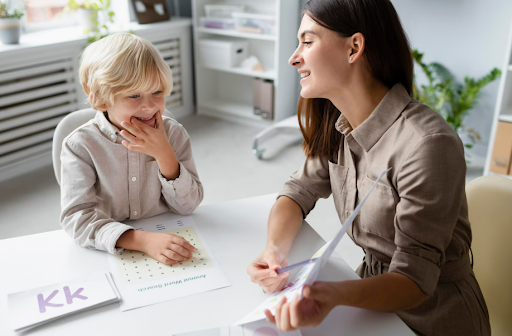
If your child speaks in movie quotes, repeats song lyrics, or echoes phrases they have heard — you are not alone. This style of communication has a name: gestalt language processing. And far from being a problem, it is simply a different pathway to language.
More parents are discovering that their child's unique way of speaking is not a delay — it is a natural form of child language development. This guide explains what gestalt language processing means, how children progress through the GLP stages, and how you can support natural language growth at home.
Key Takeaways
- Gestalt language processing is a natural style of child language development — not a disorder
- Children who are gestalt processors learn language in chunks before breaking it down into single words
- There are six GLP stages that lead to flexible, self-generated speech
- Echolalia and scripting are meaningful communication
- Speech therapy supports — rather than corrects — this natural pathway
- Parents play a powerful role in nurturing natural language growth
What Is Gestalt Language Processing?
Gestalt language processing describes how some children learn language by absorbing whole phrases first, rather than starting with single words.
Think of it this way: some children build language like stacking individual bricks. Others start with a whole wall and gradually learn to rearrange the pieces. Neither approach is wrong — they are simply different routes to the same destination.
A child using gestalt processing might say "Let's get out of here!" not because they want to leave, but because they have linked that phrase to a feeling of excitement. The words carry emotional meaning, even if they are not used literally.
This style of child language development was first identified by Dr Barry Prizant in 1983 and later expanded by speech and language therapist Marge Blanc, who developed the Natural Language Acquisition framework. Research published in ASHA Perspectives confirms that gestalt development follows a predictable progression — one that therapists can support with the right approach.
If your child echoes dialogue, repeats familiar phrases, or uses scripts from their favourite shows, they may be a gestalt language processor. And that is not something to fix. It is something to understand.
Not sure whether this applies to your child? Here are some common signs:
Signs Your Child May Be a Gestalt Processor
Not sure whether this applies to your child? Here are some common signs:
- Repeats phrases from films, songs, or books — often with the same intonation
- Echoes what others say, either immediately or hours later
- Uses long strings of sounds that have a clear melody but unclear words
- Returns to the same phrase when experiencing similar emotions
- Seems to "script" parts of conversations rather than responding spontaneously
These are not signs of something going wrong. They are signs of a child finding their own way into language — and doing so meaningfully.
Understanding the Six GLP Stages
Children who process language this way move through six GLP stages. Each stage builds on the last, leading toward flexible, original speech.
|
Stage |
What Happens |
Example |
|
1 |
Whole gestalts — phrases used as single units of meaning |
"To infinity and beyond!" (expressing excitement) |
|
2 |
Mitigations — chunks are shortened or recombined |
"To infinity" + "Let's go!" |
|
3 |
Single words and two-word combinations emerge |
"Go" → "Mummy go" |
|
4 |
Simple grammar begins |
"Mummy is going" |
|
5 |
More complex grammar — tenses, pronouns |
"Mummy went to the shop" |
|
6 |
Flexible, self-generated language |
Full original sentences |
Children do not need to rush through these stages. In fact, pushing too fast can disrupt the natural process. The goal is not speed — it is supporting natural language growth at each step.
Some children move through stages quickly. Others spend longer at certain points. Both are normal. What matters is that the child feels understood and supported along the way.
How Gestalt Language Processing Supports Natural Language Growth

When parents and professionals recognise gestalt language processing, something shifts. Instead of trying to correct a child's speech, they begin to work with it.
Traditional approaches often focus on teaching single words through repetition and drills. But for a gestalt processor, this can feel unnatural — like being asked to learn a song one note at a time instead of hearing the whole melody first.
When we honour the way a child naturally learns, we build trust. And trust is the foundation of communication.
Children who feel understood are more willing to communicate. They take risks with language. They try new combinations. They progress — not because they are being corrected, but because they are being met where they are.
Frontiers in Psychology confirms that echolalia — once considered meaningless repetition — is now understood to be an effective communicative strategy. Children use echoed phrases for turn-taking, requesting, labelling, and maintaining social interaction. Recognising these functions helps parents and therapists respond in ways that support natural language growth rather than discourage it.
Source: Pascual et al. (2023). Functional echolalia in autism speech: Verbal formulae and repeated prior utterances as communicative and cognitive strategies. Frontiers in Psychology. (PMC9997079)
How Speech Therapy Helps Gestalt Processors
A speech therapist trained in gestalt language processing can identify which stage your child is at and tailor support accordingly.
Therapy for gestalt processors looks different from traditional speech therapy. It is child-led, play-based, and focused on connection rather than correction.
What therapy might include:
1. Acknowledging gestalts — recognising that your child's phrases carry meaning, even if they are borrowed from elsewhere
2. Modelling mitigations — showing how phrases can be shortened or recombined in natural moments
3. Expanding language in context — building on what your child says during play, routines, or shared experiences
4. Guiding parents — helping you understand how to support child language development at home
The therapist's role is not to replace your child's language style with something "better." It is to support the natural progression from echoed phrases to flexible, self-generated speech.
At The Speech Practice, our therapists understand that every child's journey is unique. We work alongside families to nurture communication in a way that feels right for each child.
What Parents Can Do at Home

You do not need specialist training to support your child's natural language growth. Small, everyday moments can make a big difference.
Simple strategies to try:
- Jaw misalignment (underbite or overbite)
- Hearing abnormalities
You do not need specialist training to support your child's natural language growth. Small, everyday moments can make a big difference.
Simple strategies to try:
Your child is already communicating. Your job is to listen, respond, and gently guide — not to overhaul how they speak.
Frequently Asked Questions
Is gestalt language processing the same as autism?
Not necessarily. Many autistic children are gestalt processors, but not all gestalt processors are autistic. Gestalt language processing is a style of learning language — not a diagnosis.
Will my child stop using echolalia?
With support, children naturally progress through the GLP stages. Echolalia does not simply disappear — it evolves. Those early scripts become the raw material for original, flexible language.
How long does progress take?
Every child moves at their own pace. Some progress quickly; others take more time at certain stages. The focus should always be on meaningful communication, not milestones.
Take the Next Step
If you recognise your child in this article, know that support is available — and it does not have to feel overwhelming. Understanding gestalt language processing is the first step. The next is finding the right guidance to help your child thrive.
At The Speech Practice, we support families across Singapore with compassionate, evidence-informed speech therapy tailored to each child's unique way of communicating.